The Solar System : Moons
OPENING QUESTION: Why do you suppose one of the criteria for defining a planet is that it has "cleared its orbit".
What what are the other criteria for a 'celestial body' (an object in space) to be defined as a planet?
OBJECTIVE: I will be able to state at least 2 properties of moons in our solar system after today's class.
CALENDAR: Solar System test on Friday (9/20/2024)
WORD FOR TODAY:
- solar nebula (star nursery)
- super nova (exploding star)
- Sol ("Our Sun")
- Asteroid ("Rocks in space" otherwise known as "Flying Potatoes" )
- Comet ("A dirty snowball")
- Meteor ("Rocks falling to Earth")
- Moon ("A rocky body orbiting a planet")
- Planet ("A spherical body orbiting a star")
- Mercury (rocky)
- Venus (rocky)
- Earth (rocky)
- Mars (rocky)
- Jupiter *(gas giant and has rings!)
- Saturn *(gas giant has rings!)
- Uranus *(gas giant has rings!)
- Neptune *(gas giant has rings!)
- Dwarf Planet:
- Pluto
- Eris
- Haumea
- Astronomical Unit (1 AU = 150,000,000 km = ~ 100,000,000 miles)
Thea ("Smacked into Earth, nearly destroying our planet")
WORK O' THE DAY:
A moon, by definition, must orbit another 'celestial body'. Planets can have moons, asteroids can have moons, comets don't have moons.
Why not? (Oh now THAT would be a great test question, don't you think?)
It may surprise you to learn (if you don't already know!) that the moons of our solar system are at LEAST as interesting as the planets they orbit. In fact, there's a strong argument to made that the moons of our solar system are worth a great deal more study than the planets they orbit.
Let's see if you agree!
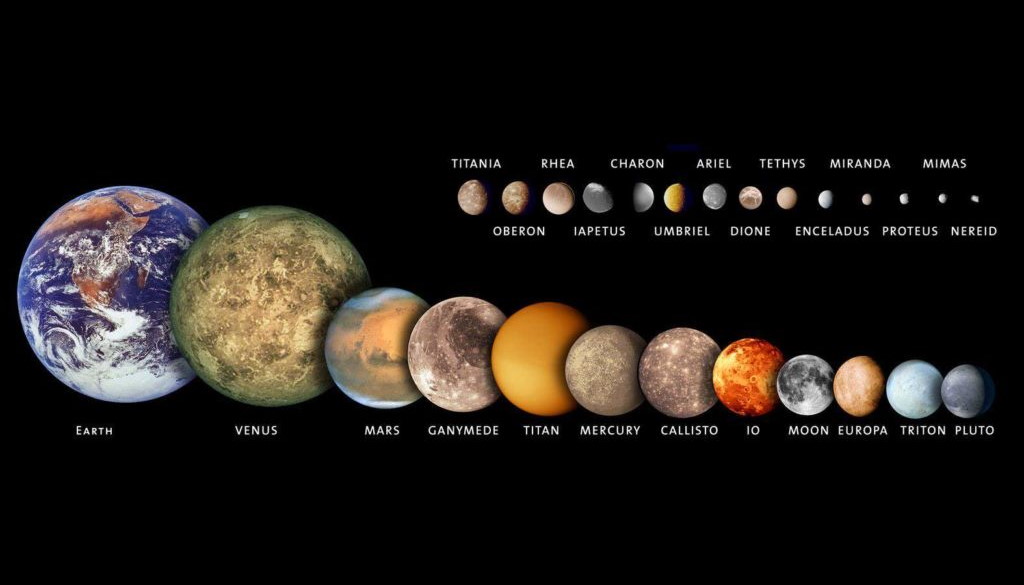
Please observe closely (click on each moon for a close-up image. NOTE: several images can be clicked again for an even closer close-up) the following images of moons from around our solar system (please note, these images are very definitely NOT to scale)
Also, please make sure you can pronounce each of these too (You can find that online but it may take some digging!)
Ganymede - Jupiter has a massive (probably salty) ocean just under its surface |
Encelades - Saturn Astro biologists are keen to explore this moon for life |
Titan - Saturn the only known moon with an atmosphere! |
Deimos - Mars (a captured 'flying potato') |
IO - Jupiter is the most volcanically active body in our solar system. Its volcanoes spew sulfur! |
The Moon - Earth (proper name Luna) |
Charon - Pluto Very close in size to Pluto |
Europa - Jupiter Note the many lines on the surface - cracks in the surface created by impacts/collisions filled by subsurface water and refrozen |
Phobos - Mars (another flying spud!) |
Callisto - Jupiter |
 |
|
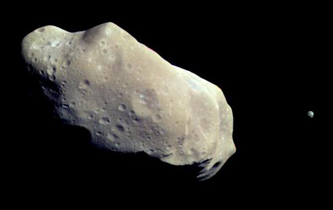
Asteroid 243 Ida with small moon |
||


═══════════════════════════
Moon comparisons:
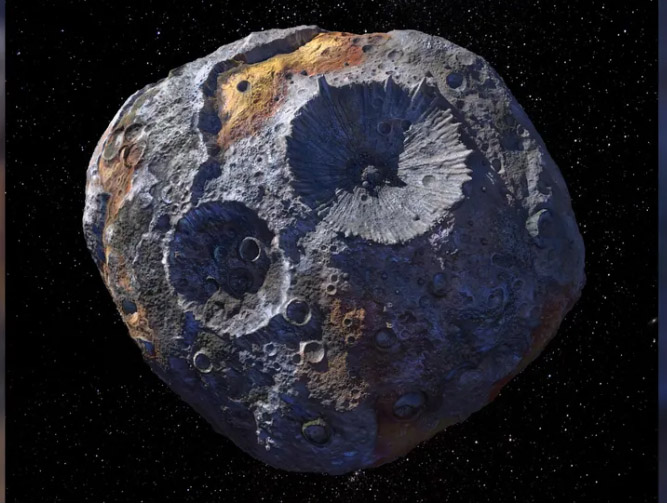
Psyche 16 - Is there really that much gold there?
The "Galilean Moons"
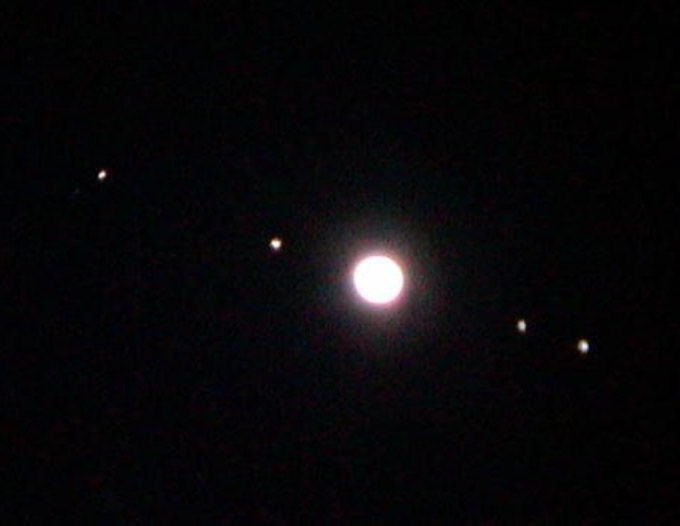
When Galileo pointed his very first telescope at Jupiter in the early 17th century (1610 actually) he saw THIS:
He correctly reported his observations that the planet Jupiter appeared to have four moons orbiting around it. He named those moons Ganymede, Io, Europa and Callisto.
He was warned about spreading such 'heresies' in 1616 but continued his writing and observations. He compiled those into "Dialogue Concerning the Two Chief World Systems" which he published in 1632.
That book supported Copernicus' claims of a "heliocentric" (sun-centered) view of the cosmos and Galileo was placed under house arrest for the rest of his life in 1633.
Evaluate the following questions and be prepared to discuss with the class:
Imagine you have to make a case to NASA to send a probe (at a cost of ~ $500,000,000) to your moon.
Find a moon that appeals/interests/captivates you
Now please find other folks who chose the same moon
Work with them folk to make *convincing* arguments why NASA should send a probe to your moon.
Keep it relatively simple, pictures are GREAT
Your goal will be to convince other team members to join/support your team!